Our Location
5th Floor, Huake Center, Lanshan District, Linyi City, Shandong Province, China

5th Floor, Huake Center, Lanshan District, Linyi City, Shandong Province, China
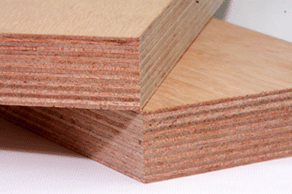
Building a plywood canoe rewards a patient builder with a light, strong boat that floats a shallow river and carries a weekend load. The stitch-and-glue method joins flat panels with wire stitches, locks them with epoxy fillets, and sheathes the hull in fiberglass. This guide covers the sheet choice, the wiring, the glue steps, and the finishing that turns a stack of plywood into a canoe ready for the water.
Plywood carries the curve and the load. A thin, stiff sheet bends into a fair hull curve without a frame, and its crossed plies spread the load of a paddler and a pack across the bottom.
The light weight helps on the water. A plywood hull lifts onto a roof rack and carries across a portage, while a heavier formed hull drags on both, so the sheet weight earns its place on a small boat.
Definition: stitch-and-glue boat building wires flat plywood panels into a hull shape, locks the seams with thickened epoxy, and covers the joints with fiberglass tape so the shell becomes one stiff, watertight skin.
The glue line matters most. A strong, gap-filling epoxy joins the panels into a single shell, and a weak or starved joint opens under flex and lets the water in.
The method suits a first build. A small shop, a set of plans, a few clamps, and a flat floor carry the whole job, so a canoe is a real project for a careful home builder.
The plan sets the hull shape. A set of drawings prints the panel sizes, the seam lines, and the waterline, and the builder follows those numbers rather than guessing a curve.
A flat floor starts the job. A smooth, level surface lets the panels sit true while the stitches pull the shape, and a crooked floor twists the hull before the glue sets.
The grade decides the life of the boat. A marine-grade or exterior-bond plywood holds its glue line in water, while an interior panel delaminates once the hull soaks and flexes.
Thickness follows the length. A short canoe takes a thin sheet for a light hull, and a longer, heavier boat wants a thicker panel to hold stiffness across the span between the thwarts.
The face grade shapes the finish. A clear face shows a bright, varnished hull, and a patched face suits a painted shell, so the buyer picks the face for the finish the boat will wear.
| Boat length | Hull thickness | Build feel |
|---|---|---|
| Short solo | Thin sheet | Light, flexible |
| Mid touring | Medium sheet | Balanced |
| Long tandem | Thicker sheet | Stiff, heavier |
The bond class is non-negotiable. An exterior or marine glue line holds through soaking and drying cycles, and that bond keeps the plies joined for the life of the canoe.
The drill layout guides the wires. Even holes along the seam line let the stitches pull an even curve, and a crowded or missing hole leaves a flat spot in the hull.
Definition: a stitch is a short wire loop through paired holes along two panel edges, twisted tight to pull the panels together and hold the hull shape until the epoxy sets.
The wires come out after the tack. Once the epoxy tacks the seams, the builder pulls each wire and fills the small hole with a dab of thickened epoxy, so the hull closes clean.
The build starts flat. The builder lays the side panels and the bottom on the floor, drills the stitch holes at the seam line, and wires the panels into a loose hull.
The stitches shape the boat. Wire loops pull the seams together and hold the curve, and the builder opens or closes the hull around the center until the shape matches the plan.
Use these steps at the bench and the hull:
The fillet turns a seam into a joint. A bead of thickened epoxy spreads along the inside of each seam and ties the panels together, and the tape over the fillet carries the load.
Fairness shows in the finished hull. A true shape holds an even curve from bow to stern, and a builder who checks the hull against the plan catches a twist before the epoxy sets.
The tack weld holds the shape. A small bead of thickened epoxy at a few points locks the seams before the builder removes the wires, so the hull keeps its line through the fill.
A fair curve rewards patience. Checking the hull against the plan at each step catches a twist early, when an easy adjustment still protects the finished shape.
A steady hand keeps the shape. The builder works one seam at a time and checks the hull line again, because an early correction costs far less than a re-cut panel.
The glass sheathes the wood. A layer of fiberglass cloth set in epoxy covers the hull, and the composite skin protects the plywood and adds the stiffness a thin shell needs.
Epoxy seals the whole boat. The resin fills the cloth weave, coats every surface, and keeps water out of the plywood, so the sealing step decides how long the canoe lasts.
The outside takes the wear. A hull that scrapes a rock or a ramp wants a full glass cover on the outside, and the interior gets a lighter coat that seals the wood without extra weight.
The finish protects the resin. A marine varnish or a boat paint shields the epoxy from sunlight, and the coating slows the chalking that ages an exposed resin surface.
A clean shop floor helps the lay-up. A smooth surface lets the cloth sit flat and the resin wet out evenly, so the builder avoids bubbles and dry patches under the glass.
Glass adds strength and weight. A full cover stiffens the hull and raises the build weight, and the builder balances the two against the load the boat will carry.
A load test on the water settles the build. The builder floats the canoe with the planned weight, and the freeboard shows whether the hull carries the gear the plan promised.
The finished boat stays light. A plywood-and-glass canoe lifts onto a car roof with one hand, and the light hull tracks well on flat water where a heavier boat feels sluggish.
The load capacity follows the volume. A wider, deeper hull floats more gear and sits stable, and a narrow racing shape carries less yet glides farther on each stroke.
| Hull type | Weight feel | Load use |
|---|---|---|
| Narrow solo | Very light | Day paddles |
| Everyday touring | Light | Weekend trips |
| Wide tandem | Moderate | Two paddlers and gear |
The plans set the numbers. A designer prints the panel sizes and the waterline for the intended load, so the builder follows the drawing rather than guessing a shape.
Sheet supply carries the whole build. A builder orders a marine-bond panel for the hull and a lighter sheet for the interior parts, and both can ship as Commercial Plywood in the exterior grade or as Film Faced Plywood for a tough jig table.
The technical desk at HYY confirms the marine or exterior bond and the face grade, so the boat starts from a sheet that holds up in water.
Store the hull dry between sessions. A drained, covered boat keeps the wood and the epoxy sound, and a wet, tight cover traps the moisture that ages the shell.
A repair stays simple. A small crack or a scrape takes a fresh fill of thickened epoxy and a patch of glass, so the owner keeps the canoe on the water for years.
The weight budget follows the glass. A lighter interior coat and a careful fill trim the final number, and the builder keeps the hull easy to carry.
These answers cover the questions that come up before the first panel meets the floor.
Only for a dry display. A boat in water needs a marine or exterior bond, because an interior glue line delaminates once the hull soaks and flexes.
Match the length and the load. A short solo boat takes a thin sheet, and a longer tandem hull wants a thicker panel that holds stiffness across the span.
The outside cover earns its cost. Glass set in epoxy protects the plywood, stiffens the thin shell, and adds the abrasion resistance a beaching hull needs.
A light solo hull lifts with one hand, and a larger tandem boat weighs more, so the sheet thickness and the glass schedule set the final weight.